Quick Nav
- Three Conditions That Keep an IRTF Research Group Alive
- Research Time Against the Standards-Track Deadline
- Academic, Industry, and Civil-Society Reasons to Remain
- Mailing-List Labour Between Research Group Meetings
- Who Stays Decides Which Internet Problems Stay Open
- Check the Charter and a Year of the List Before You Commit
Three Conditions That Keep an IRTF Research Group Alive
The room is perhaps a third full. It is the research-group slot in an IETF meeting week, a single agenda block of an hour or two, and the chair opens with housekeeping. The draft editor has rotated off. Two new names have appeared on the mailing list since the last meeting. A question comes up about why the group abandoned a particular measurement approach, and the only person who can reconstruct that decision is joining remotely from a university office. She will not be funded to attend the next meeting.
Nothing in that session breaks a rule. Subscription is open, remote participation has been a regular channel since the 2020 meeting cycle, and new contributors keep arriving. A reasonable expectation, and the one most participants bring to the IRTF, is that openness of this kind sustains a research group on its own.
I tested that expectation against the scene itself. The remote link covered the slot. It did nothing for the 14 to 20 weeks before the next meeting week, during which the reasoning behind the dropped measurement approach would either be written into the list archive or disappear with the one person who held it. The two new names could read the archive, but they could not read a decision that was never posted.

The expectation holds for entry and fails for continuity. Three conditions keep a research group alive: a research horizon that runs longer than any standards-track deadline, incentives that differ for universities, firms and civil-society organisations, and work that continues on the mailing list between meetings.
Small Core, Open Door
Continuity among a small set of contributors is what turns an open door into a living research agenda. The newcomers matter; the people who carry drafts across meeting weeks decide whether there is anything for newcomers to join.
Research Time Against the Standards-Track Deadline
The participation rule in IETF and IRTF venues looks almost identical: anyone may join. The payoff schedule differs sharply. Set side by side, the two kinds of group compare as follows.
- Purpose. An IRTF research group explores problems that are not yet, or may never be, ready for a standard. An IETF working group is chartered to produce consensus specifications.
- Expected output. Research groups produce drafts, informational documents and shared understanding of an open problem. Working groups produce specifications intended for the standards track, tied to dated milestones under the 1998 working-group guidelines (RFC 2418).
- Lifetime. Research groups persist as long as the question remains productive. Working groups close when their milestones are met or abandoned.
- What counts as progress. In a research group, progress is better understanding of a problem. In a working group, it is convergence; the 2004 IETF mission statement (RFC 3935) frames output as technical documents that influence how the Internet is designed, used and managed.
One procedural anchor changes where a reader should put an unfinished question. The IRTF Research Group Guidelines and Procedures (RFC 2014), published in October 1996, orient research groups toward research purpose and open discussion. A problem that still needs inquiry therefore belongs in a research group; a working group that must converge will treat it as an obstacle to its milestone.
The clock mismatch shows up in who leaves. A contributor whose employer scores protocol shipment in chartered months will feel a research group slow across even one inter-meeting gap, while a contributor scored on insight will find a working group closed once its milestone demands convergence. That explanation holds where the home scorecard is a shipping deadline or a publication cycle that cannot accommodate an open question; it says little about contributors whose funded question already runs on the research group's own horizon.
Academic, Industry, and Civil-Society Reasons to Remain
Reasons to stay or drift differ by sector, so they are treated here as three separate accounts.
Academics
Research-group drafts and informational documents rarely map cleanly onto publication and promotion cycles. Academic continuity is tested across successive annual review or publication rounds spanning 24 months or more. An academic stays when a multi-year question can be carried inside ordinary research time; meeting attendance alone will not hold one in place.
Industry
Staffing follows funded product and standards work. A roadmap shift can withdraw an engineer within a single inter-meeting gap, which makes open-ended research easier to join than to keep. Intellectual-property caution adds friction: an internal review can consume several weeks of that same gap before a design reaches the open list.
Civil-society organisations
Participation depends on staff time plus travel for up to three meeting weeks in a twelve-month span. A research-council or foundation award that pays for one trip does not, by itself, staff list review between meetings. One funded advocate can cover at most one session slot per meeting week. Editing a draft, answering objections and attending the next meeting requires more than that one person can supply.
Mailing-List Labour Between Research Group Meetings
Start with the working surface as it appears in the record:
- An in-person session lasts an hour or two and gathers whoever could travel that week.
- Between sessions lies a gap of roughly 14 to 20 weeks, during which the list is the only shared space.
- A twelve-month window of the archive covers three in-person sessions and the written intervals between them.
- Draft revisions and objections posted in the weeks after a session survive the departure of their authors; minutes kept only in the room do not.
Read together, these place review, objection and draft progress on the list. The session opens or closes a gap; the list is where the thread is carried across it.
That split decides who remains. A newcomer who only attends the room meets the people. A newcomer who only reads the list meets the argument, and can join it from anywhere.
Groups that relocate decisions into the room lose everyone who cannot travel, including many academic and civil-society contributors who join remotely.
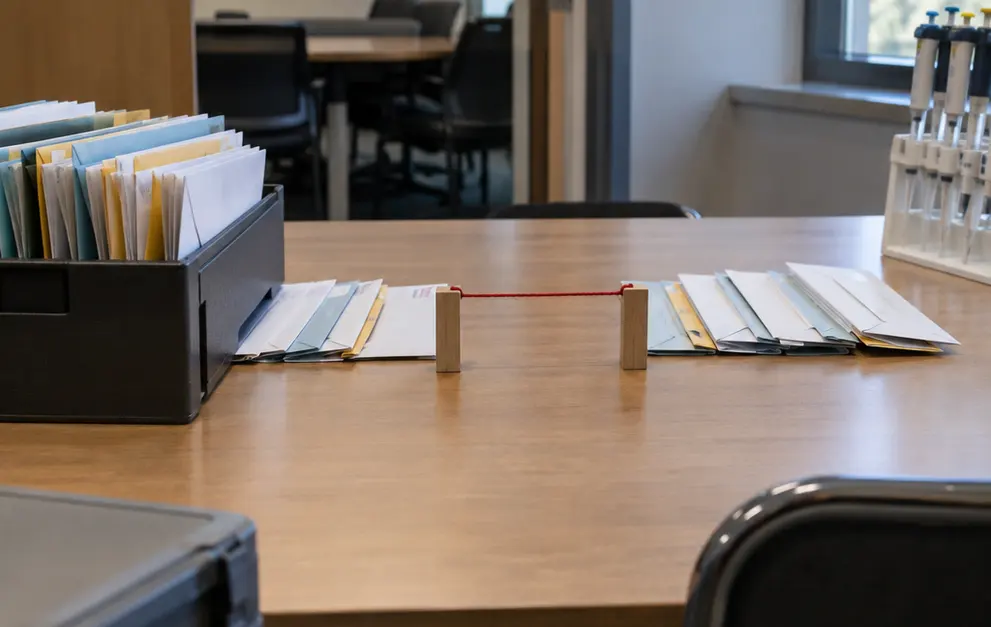
Fund the Written Thread
If your organisation can support only one channel, support list labour. Staff review through the full inter-meeting gap, including for colleagues who join remotely. Meeting presence without written follow-through will not keep a research thread alive.
Who Stays Decides Which Internet Problems Stay Open
Scholarship such as The Global War for Internet Governance (Yale University Press, 2014) established that technical standards-setting is a site of governance, with public-interest consequences. That work left a narrower question less settled: inside an open venue, how does the agenda actually form? Debates over multistakeholder governance tend to focus on entry, on who may participate and under what rules.
This article treats agenda formation as a continuity effect. Open subscription lets new people arrive. The problems that remain on a research group's agenda are the ones a continuing editor, chair or small core still has reason to carry. Across three meeting weeks in a year, open subscription can add names at each session while the active drafts remain those a small continuing core has edited on the list.
Openness Can Mask Steering
A research agenda can look open while being steered by whoever can afford to remain: well-supported industry researchers on multi-quarter assignments, a few long-horizon academics, or a civil-society advocate whose grant still covers the work.
The consequences reach later standards work. If no second editor posts revisions in the weeks after a champion's last session, the thread is absent from the next meeting's slot, and it never enters the background that later working groups inherit. Topics a stable core keeps alive become the research context policymakers and standards participants later treat as given. Civil-society influence over which Internet problems stay open therefore tracks whether grant-covered staff time lasts through a full year of cycles, regardless of how many meeting badges were issued.
Check the Charter and a Year of the List Before You Commit
Before assigning staff time or travel money to an IRTF research group, read its charter and the past twelve months of its mailing list. Name the person whose revisions carried each active draft across those three meeting cycles; the newest names on the subscription list will not tell you this. Commit only if your organisation can support that labour for the group's actual horizon.
The same instruction applies differently by role:
- Civil-society organisations: budget list labour across the 14-to-20-week intervals before you budget the trip.
- Academics: attach the group to a question you can carry for 24 months or more inside ordinary research time.
- Policymakers: treat research-group output as input to a later working-group charter, and keep it off any standards delivery milestone.
This week, open the archive of the research group you are considering, list every active draft, and write beside each one the editor who posted its last three revisions. If any draft has no name beside it, that is the gap your organisation would be funding.