

Technical standards need civil society at the table
Internet governance is decided in closed rooms. Our project maps where civil society can intervene and measures the difference it makes across IETF, OASIS and multistakeholder forums.
Latest Research Outputs








Earlier studies mapped formal rules. They left open how those rules shape actual attendance and influence over time.
Our approach starts with meeting records and mailing list archives. It then traces individual contributions through working group cycles.
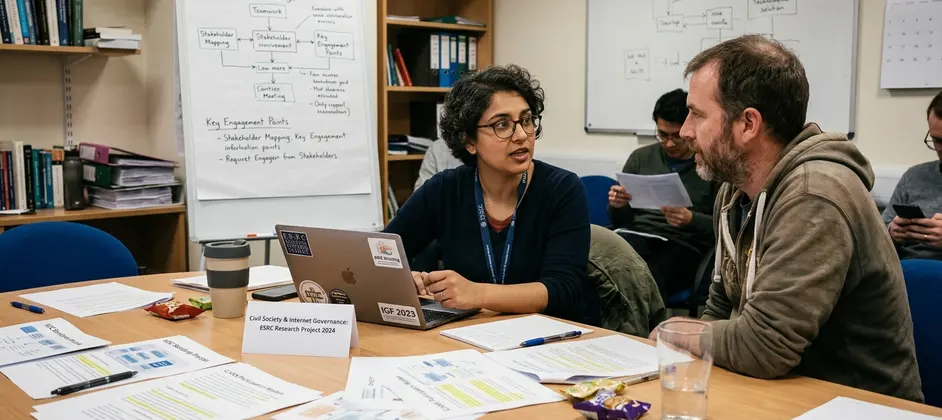
Field methods
Observers expected higher civil society turnout after guideline changes around 2015. We tested that claim by coding every IETF working group session from around 2010 onward for attendee affiliation.
Process tracing showed modest gains in observer status but little shift in document authorship. Limits appear when groups lack sustained funding for travel.
Decision records
Monitoring data shows IETF chairs record fewer formal votes after around 2018. Instead they rely on humming and mailing list summaries.
These patterns suggest informal consensus tools can sideline newer participants who miss hallway exchanges. One remaining question is whether similar shifts appear in OASIS technical committees.

Project team

James Loud, Research Fellow. Comparative analysis of civil society participation across Internet standards organisations.

Seamus Simpson, Professor. First-principles theory of communication governance and institutional legitimacy.

Alison Harcourt, Senior Lecturer. Real-world case studies of standards participation, regulation and civil society advocacy.

Imir Rashid, Qualitative Researcher. Research methodology, fieldwork design and process tracing in standards organisations.

George Christou, Reader. First-principles analysis of cybersecurity governance, standards power and international order.

Dr Siobhán MacLeod, Senior Research Fellow. Comparative analysis of civil society participation in Internet standards bodies.
How We Approach Research
Define
Pinpoint the central research problem.
Search
Locate pertinent academic publications.
Theory
Ground the work in established models.
Examine
Carry out methodical inquiry.
Conclude
State the distinct scholarly insight.